
One price,
every
channel.
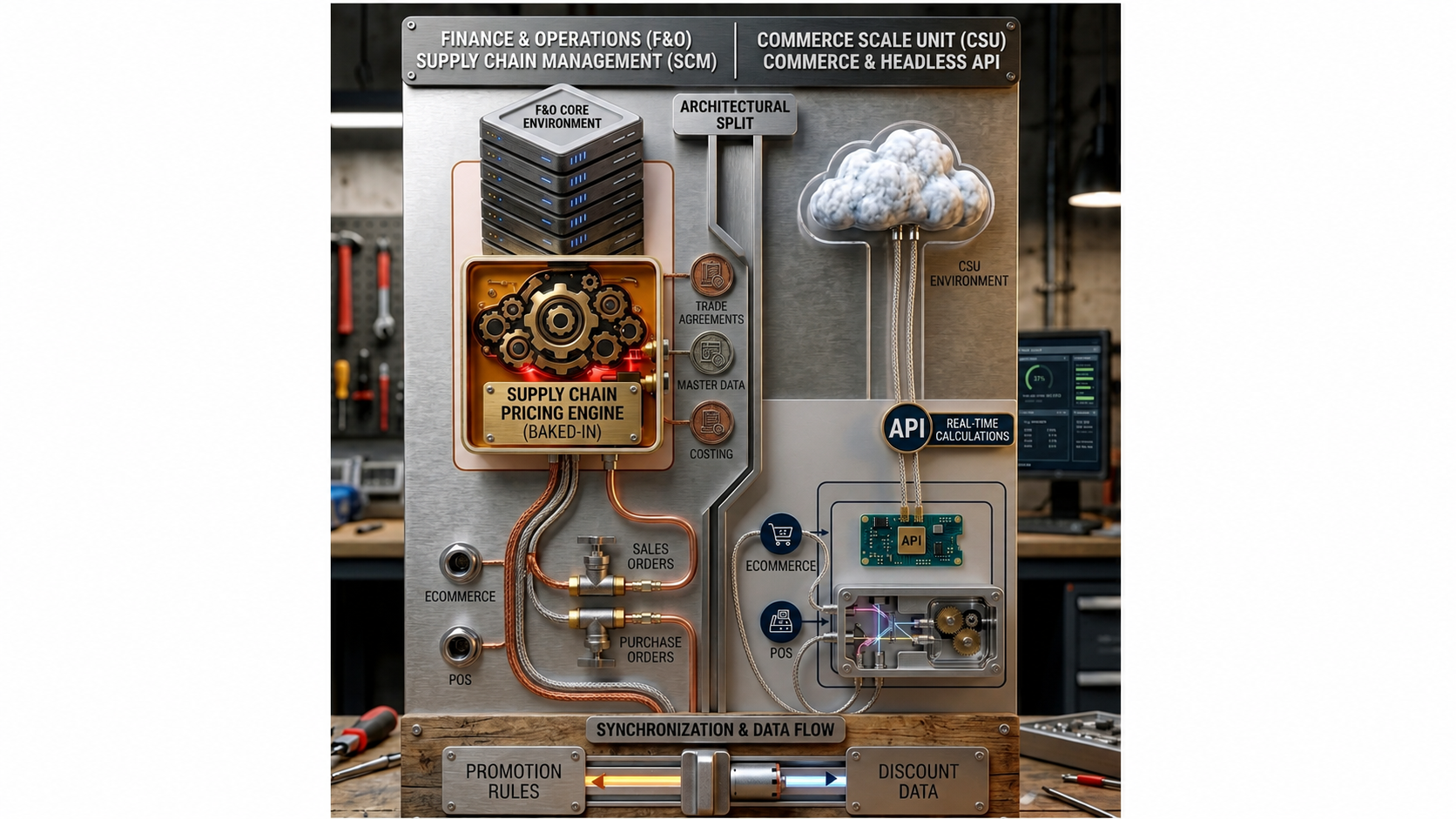
Omnichannel pricing rarely fails on the ERP side. It fails between channels - where the same customer and the same product can resolve to different prices. Microsoft's UPM closes that gap behind one API.
Pricing is an
omnichannel problem.
- The same price has to appear in the ERP, the B2B e-shop, the point of sale, the call centre and customer service - and it has to match. The moment each channel calculates on its own, the omnichannel promise breaks: identical baskets return different totals.
- There are only two ways to stay consistent - replicate price data into every application, or centralise the calculation behind one service. Replication looks simple until B2B complexity arrives.
- Attribute-based pricing - where discounts and adjustments are triggered by attributes on the product, the customer and the order - is a layered architecture that's hard to copy faithfully into a third-party commerce engine, or into Customer Engagement, which has no native pricing engine.
The cost is real: replicated pricing logic is expensive to build and expensive to run, in both Capex and Opex. Every channel that calculates on its own is another place your prices can quietly drift apart.
From fragmented calculations
to one pricing engine.
UPM doesn't replace your Dynamics 365 investment. It centralises the calculation every channel already depends on - so the value is in the architecture, not the switch.
Without UPM
- Price logic duplicated across ERP, commerce and POS
- B2B attribute-based rules rebuilt, imperfectly, in third-party engines
- Customer Engagement with no native pricing logic of its own
- Identical baskets, different totals across channels
- Two disconnected engines - Supply Chain and Commerce
- Trade-agreement pricing that doesn't travel beyond F&O
Unified Pricing Management
- One centralised pricing API every channel calls
- Attribute-based rules and the discount layer in a single service
- Customer Engagement consumes the same calculation as commerce
- Same basket, same total, every channel
- One engine, built on the Commerce Scale Unit
- Portable pricing that reaches POS, webshop, call centre and beyond
Three engines. One built
for portability.
UPM is a centralised, attribute-based pricing framework - price attributes, price component codes and price trees - that extends trade-agreement pricing, linking it to the attributes that now trigger pricing and discount rules, and applies the same rules across ERP, commerce and POS. Its lineage matters.
Supply Chain (Trade Agreement)
Over twenty years old and embedded in F&O. Capable, and later gained attribute-based pricing for B2B - but never exposed as a portable service.
Commerce Pricing
Introduced with AX for Retail around 2012. API-based, with an advanced discount layer and support for auto price rules based on cost price and other reference points.
Unified Pricing Management
Combines Supply Chain's attribute management, Commerce's advanced discount layer, and a pricing tree that auto-generates sales pricing from cost price and other reference points. Trade agreements remain core - now triggered by attributes, not standalone.

One engine.
Every channel unblocked.
UPM changes what's possible for every team that depends on pricing being right, everywhere, at once.
CFO
Margin protected by design. One governed calculation means discounts stack the same way everywhere - no channel quietly eroding margin.
COO
No more reconciling price discrepancies between the ERP, the webshop and the call centre. One source of truth removes the manual checking.
CIO / CTO
One pricing service instead of duplicated logic in every channel. Less to build, less to maintain, less that can drift out of sync.
Commercial / E-Commerce Lead
Attribute-based, B2B-grade pricing available to every storefront - including Customer Engagement, which has no native pricing engine of its own.
One pricing engine.
Every channel calls it.
From the point of sale to the call centre and every commerce surface in between, UPM sits behind a single API - so every channel calculates the same price, the same way.
Four places we
typically add value.
365Connect has built on the Commerce engine since 2016 - from Retail Server through to the Commerce Scale Unit - and on AX for Retail since 2010. We advised customers on UPM while it was still in preview, working directly with members of the Microsoft product group building it.
Pricing-Service Boundary
Designing what UPM owns, and what Customer Engagement, a third-party storefront, or a portal consumes.
Faithful Model Mapping
Translating attribute-based pricing faithfully when a non-Microsoft commerce engine sits in front of the calculation.
Concurrency & Governance
Deciding which rules stack, which win, and who owns them - to protect margin.
Cost-Plus & Margin Design
Category price rules built on markup or margin over base cost - that hold up only as well as the underlying cost data.
| Pricing engine | Portable API | Strength |
|---|---|---|
| Supply Chain (trade agreement) | No - embedded in F&O | 20+ years; trade agreements, later attribute-based pricing |
| Commerce pricing | Yes - API-based | Introduced with AX for Retail (~2012); advanced discount layer, auto price rules from cost price references |
| Unified Pricing Management | Yes - via the UPM endpoints built into CSU | Combines SCM attribute management + Commerce discount layer + pricing tree; trade agreements remain core |
See Unified Pricing Management
in action.
Attribute-based pricing calculated once and reused across the webshop, POS, call centre and Customer Engagement - all running against a real Dynamics 365 environment. Watch this space for the demo video.
Demo video coming soon
The value is in the architecture,
not the switch.
If you are moving to omnichannel pricing on Dynamics 365, the first question is not "how do we configure UPM" - it is "where should price be calculated, and who consumes it." That is the conversation we like to have.
Beyond a switch.
A pricing architecture that travels.
Consistent Pricing, Every Channel
Identical baskets return identical totals - because every channel calls the same calculation, not a replica of it.
Attribute-Based Rules, Portable
Price attributes, price component codes and price trees apply the same way across ERP, commerce, POS and Customer Engagement.
Built on What You Already Run
The UPM endpoints on the Commerce Scale Unit run the same calculation already pricing your POS and webshop. No new pricing logic to learn.
Advisory from the Ground Up
We've built on the Commerce engine since 2016 and advised customers on UPM since preview - working directly with the Microsoft product group.
365Connect has built on the Commerce engine since 2016 - from Retail Server through to the Commerce Scale Unit - and on AX for Retail since 2010. We grew up with the portable engine, its APIs and the omnichannel pricing problem it was designed to solve. That is precisely the ground UPM now stands on. We work across B2B, B2C and mixed models - wholesale, distribution, manufacturing and retail - so the move from retail discounting to B2B attribute-based pricing is familiar territory, not a leap.
Ready to figure out where
price should be calculated?
If you are moving to omnichannel pricing on Dynamics 365, the first question isn't "how do we configure UPM" - it's "where should price be calculated, and who consumes it." That's the conversation we like to have.

Innovation
Fresh, creative solutions.

Integrity
Honesty and transparency.

Excellence
Top-notch services.

COMPANY
CUSTOMER CARE
LEGAL
Copyright 2026. 365connect. All Rights Reserved.